
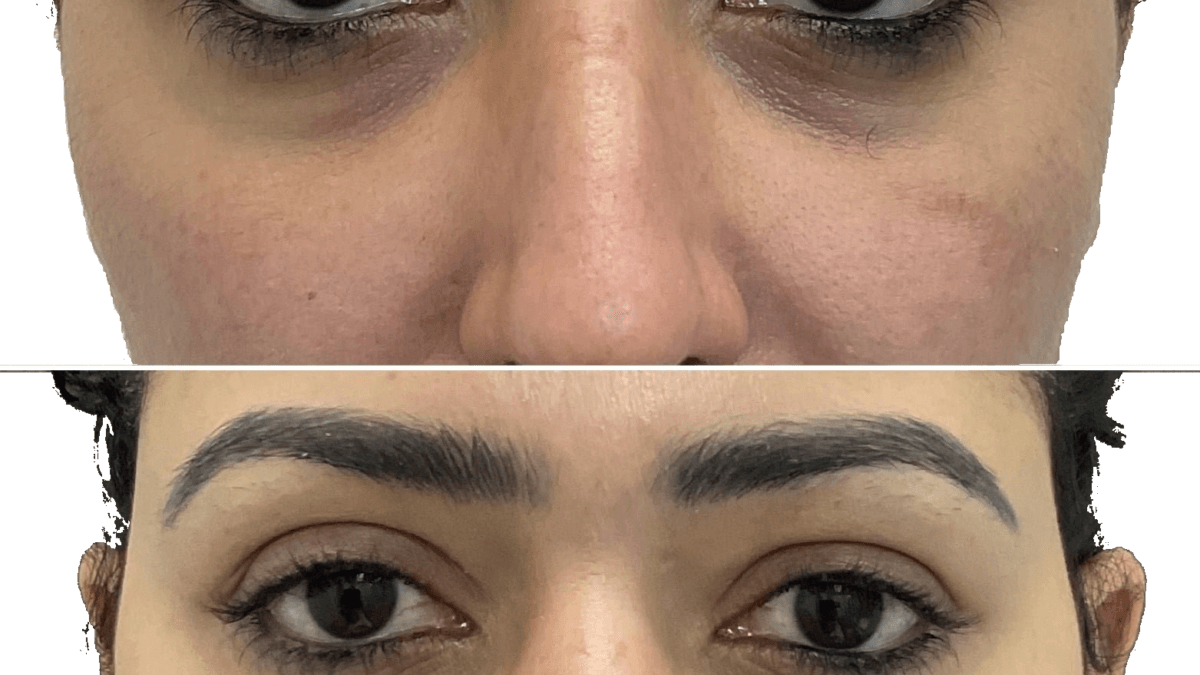
Why the Eye Area Changes: Dark Circles, Under-Eye Bags and Fine Lines
Patients often tell me that their eyes look tired even when they feel well. Some point to dark circles. Others notice puffiness, fine lines, heavier upper lids or a hollow between the lower eyelid and cheek. These concerns can look similar in a photograph, but they do not always come from the same part of the face.
That is why I find the periorbital region—the area around the eyes—so interesting. The skin, muscles, fat compartments, ligaments, bone and brow position all shape what we see. In a consultation, I look at those layers together before recommending anything. A treatment that helps one person with “tired eyes” may be the wrong choice for another.
This guide explains the changes I commonly assess and the roles that PRF, dermal filler, neuromodulators such as Botox and Dysport, ablative laser resurfacing and skincare may play in eye rejuvenation. It also explains when a surgical opinion may be more useful.
One concern can have several causes
The skin around the eyes is among the thinnest on the face. Changes in hydration, collagen and elasticity can therefore become noticeable early. Beneath that skin, muscles repeatedly move when we smile or squint; fat compartments and supporting structures can shift; and the contours of the cheek and orbital bone change over time. Genetics and individual anatomy also matter.
Here is a useful way to frame the conversation. It is a guide to assessment, not a way to diagnose yourself or choose a procedure from a list.
| What you notice | What I may assess | Why the distinction matters |
|---|---|---|
| Dark circles or shadows | Pigment, thin skin, vascular show-through, hollowing and facial contours | A shadow caused by volume loss calls for a different discussion than skin colour alone. |
| Under-eye bags or puffiness | Fat-pad prominence, fluid retention, skin support and surrounding volume | Adding filler to a puffy area may make the concern more noticeable in some patients. |
| Crow’s feet | Repeated muscle movement and lines visible at rest | Neuromodulators address movement; resurfacing may be discussed for more established skin texture changes. |
| Crepey or loose skin | Skin quality, lower-lid support and degree of laxity | Skincare and injections have different limits from resurfacing or surgery. |
| A heavy-looking upper eye area | Brow position, eyelid skin and facial anatomy | The apparent heaviness may not come from the eyelid alone. |
Several factors often appear together. For example, a patient may have both a hollow tear trough and a prominent fat pad, or both expression lines and crepey skin. This is why the same treatment does not solve every eye-area concern.
PRF for selected early skin-quality concerns
Platelet-rich fibrin, or PRF, is prepared from a small sample of a patient's own blood. Processing concentrates platelets and fibrin that contain naturally occurring growth factors. When used around the under-eye area, PRF may support collagen production and skin quality over time. I may consider it for selected patients who notice early fine lines, thin-looking skin or some types of dark circles.
PRF works gradually. It is not a substitute for replacing significant volume, removing prominent under-eye bags or correcting advanced skin laxity. A typical starting series in my practice is three treatments spaced approximately six weeks apart, with maintenance discussed according to response and goals. That describes a common plan in my practice, not a prescription for every reader.
The evidence is still developing. A 2026 review of PRP and PRF for the periorbital area found variation in preparation methods and mixed objective results for wrinkles and texture. That uncertainty is one reason I set expectations around the individual concern rather than promising a particular result.
Dermal filler when volume and contour are the issue
As we age, or after weight loss, some patients lose volume in the temples and cheeks. The lower eyelid may then appear more separate from the cheek, creating a hollow or shadow. In these cases, I assess the entire orbital and midface region before deciding whether filler near the tear trough is appropriate.
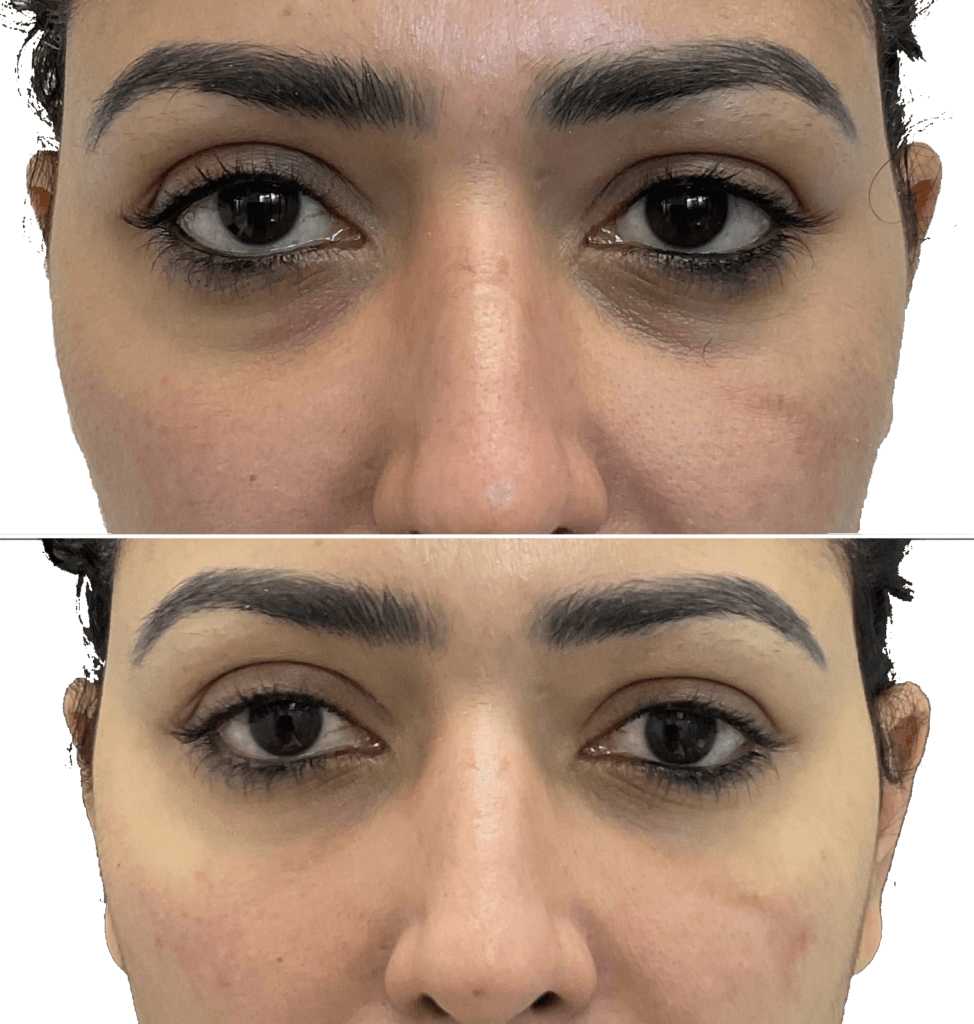
Sometimes support in the medial or lateral cheek, or in the temple, changes the appearance of the eye area without placing product directly beneath the eye. When the surrounding structures have adequate support and the hollow is isolated to the tear trough, carefully placed hyaluronic acid filler may be considered there. Small amounts can make a meaningful visual difference in a delicate area.
Filler is not right for every under-eye concern. Baseline puffiness, a tendency toward fluid retention or prominent fat pads can make someone a poor candidate for tear-trough filler. A dark circle caused mainly by pigment is also different from a shadow caused by hollowing. I would rather explain that distinction than treat every dark circle as a volume problem.
Neuromodulators for expression lines and selected brow concerns
Neuromodulators, such as Botox and Dysport, are familiar to many patients as treatments for crow’s feet. When we smile or squint, the muscles around our eyes contract and repeatedly fold the overlying skin. Neuromodulators temporarily reduce selected muscle movement, which can soften the appearance of expression lines while the treatment is active.
In some patients, carefully placed injections may also create a subtle lift at the outer brow, making the upper eye area appear more open. This depends on the person's anatomy and movement pattern. The aim is a refreshed appearance that still looks like them.
Neuromodulators do not restore lost volume, remove excess eyelid skin or fully correct deeply etched lines. When skin texture is the main concern, I may discuss a different approach rather than expecting injections to do a job they cannot do.

Ablative laser resurfacing for more established skin changes
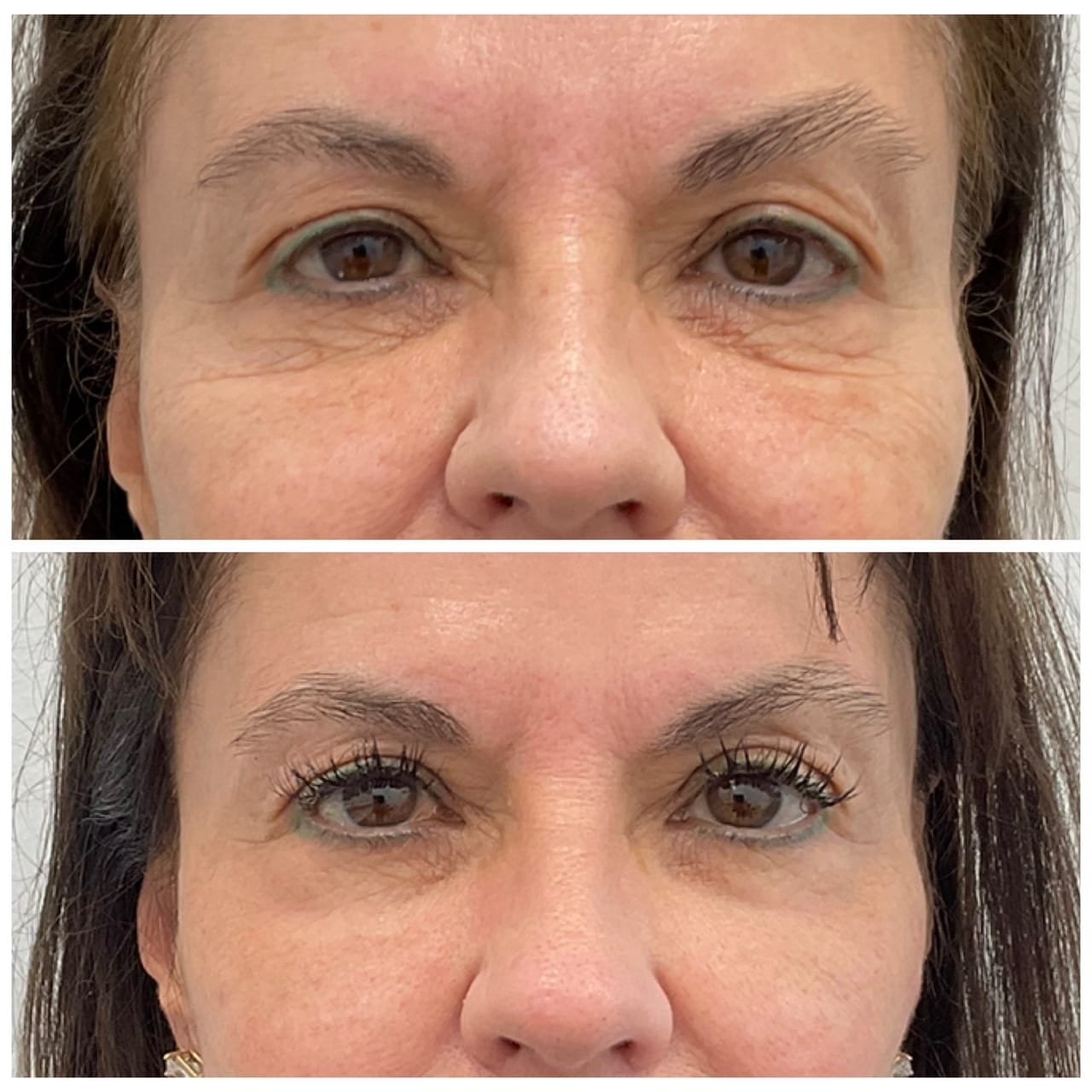
Fine lines can become visible even when the face is at rest. The skin may also look crepey or loose. During my assessment, I look at elasticity and lower-lid support, including how the skin recoils when gently pinched and released. These details help determine whether resurfacing is suitable and how much recovery a patient can accommodate.
For selected patients, fully ablative erbium laser resurfacing with Sciton Contour TRL is one of the options I consider. A 2,940 nm erbium laser removes controlled layers of skin, allowing the treated area to heal with a smoother appearance. I sometimes describe the visual goal as almost ironing out etched-in lines, though the result and treatment plan vary from person to person.
This is a more involved treatment than an injectable visit. Initial healing commonly takes one to two weeks; residual redness may last several weeks and, for some patients, longer. Preparation, aftercare and the planned treatment depth all matter. I review those details in consultation before a patient commits to treatment.
When surgery may be the better conversation
Non-surgical treatments have real limits. Significant upper-lid skin excess, prominent fat pads, substantial lower-lid laxity or a structural concern may call for a surgical opinion. In some cases, the concern also affects function, not only appearance.
I believe in being direct about what I can realistically accomplish with injections and lasers. If I do not think one of the treatments I offer will provide a meaningful improvement, I will say so. When appropriate, I am happy to guide a patient toward a plastic surgeon, facial plastic surgeon or oculoplastic surgeon for an assessment.
Where eye skincare fits
Skincare cannot reposition fat, restore a significant hollow or remove excess eyelid skin. It can, however, support hydration and the appearance of the delicate skin around the eyes. The right product depends on skin tolerance, routine and the concern being addressed.
Three eye products I currently discuss with patients illustrate different approaches:
- Pavise Precision Eye Lift is a lightweight gel-serum I favour for morning use. It hydrates and is designed to improve the visible appearance of fine lines, puffiness and dark circles while helping the eye area look firmer.
- skinbetter science EyeMax AlphaRet Overnight Cream combines a retinoid and an alpha hydroxy acid for nighttime use. I consider it when fine lines and texture are a priority, while reviewing tolerance and how it fits into a patient's routine.
- SkinCeuticals A.G.E. Advanced Eye can suit someone who prefers one eye cream for morning and evening. Its formulation includes Proxylane, peptides and caffeine and is designed to improve the appearance of crow’s feet, puffiness and dark circles.
These are examples, not a three-product routine everyone needs. I would rather choose one appropriate product than ask a patient to layer several products without a clear purpose. Prices and availability can change; the linked product pages carry current details.


Questions patients often ask
Can filler get rid of under-eye bags?
Not necessarily. Filler can sometimes soften a hollow or the transition between the lower lid and cheek, but a prominent fat pad or persistent puffiness needs a different assessment. In some patients, adding filler could make swelling or heaviness more noticeable.
Are all dark circles treated the same way?
No. Pigment, thin skin, vascular visibility and shadows from facial contours can each contribute. More than one factor may be present. The first step is to understand what is creating the appearance before discussing treatment.
Is PRF the same as under-eye filler?
No. PRF is a blood-derived treatment I may consider for selected skin-quality concerns. Hyaluronic acid filler is used to address appropriate volume or contour deficits. Neither is automatically suitable for every patient with dark circles.
Can a non-surgical treatment replace eyelid surgery?
Sometimes a non-surgical plan can improve a specific concern, but it cannot replicate the removal or repositioning of tissue achieved with surgery. If significant excess skin, fat-pad prominence or functional concerns are involved, a surgical assessment may be more useful.
How do I know which option fits my eyes?
I assess skin quality, movement, facial contours, brow position, eyelid support and treatment history together. We then discuss what each option can realistically change, its recovery and whether a staged plan makes sense. You can explore the non-surgical eye lift options available in Oakville or schedule a consultation to discuss your own concerns.
The most useful starting point is not a treatment name. It is understanding which part of the eye area is responsible for the change you are seeing.


Book your appointment
Nurse Jacklyn takes pride in serving clients in Oakville, Burlington, Mississauga, Hamilton, Toronto, and throughout the Greater Toronto Area!


